
Comprehensive Product Overview
Insight
Binary Technologies' own business management platform — a single, generic, metadata-driven engine capable of running an entire business's CRM, sales, purchasing, stock, finance, job/field-service management, scheduling, communications and reporting, continuously developed and deployed live since 2007.
19 years
in continuous production since 2007
140M+
rows in the object-engine data store, across our client base combined (estimated)
~150
built-in and bespoke reports across one deployment
V3.2
current internal platform version
1. The architecture: a generic object engine
What makes Insight a platform rather than a fixed application is a single underlying idea, carried through every module described here: business entities — jobs, assets, customer profiles, people, certificates, whatever a given business needs to track — are not hard-coded database tables. They're defined through a generic, metadata-driven object engine: an admin defines an object type, its fields (text, rich-text notes, checkboxes, dropdowns tied to managed pick-lists, date/time scheduling fields, client-lookup fields, and cross-references to other object types), the order they appear in, and over 25 independently-togglable behavioural flags per field — whether it's searchable, whether it drives email or SMS notifications, whether it feeds a report, whether it auto-inserts new values into its own dropdown, which user group gets alerted when it changes. The form itself is generated automatically from that definition — genuine entity-attribute-value architecture, not a simulation of one: on the platform's oldest live deployment alone, the underlying data-store table has grown to over 14 million rows, and across our full client base combined we estimate well over 140 million rows, real evidence this has carried real transactional weight for close to two decades, not just a demo capability.
Every object instance moves through a configurable status workflow — and a whole workflow definition can be cloned from one object type to a brand new one in a single click, so a proven process doesn't need rebuilding from scratch each time. Every workflow transition is logged to a permanent timeline (status, exact timestamp, who changed it, who it's assigned to), viewable per record, for every object type, automatically. Objects can be "intelligent": rather than a fixed assignee, a new instance is automatically routed to whichever eligible team member currently has the fewest open items of that type, decided by a live count at the moment of creation — genuine built-in workload balancing, not a manual rota.
This same engine is what powers the certificate-grade field-service forms used in the field: a statutory pressure-vessel inspection form capturing up to 16 individual ultrasonic wall-thickness readings per vessel, output as a formal PDF certificate. The record itself — task, workflow, status history, assignment — runs on exactly the same generic engine as a simple customer note; the structured measurement grid sits alongside it as its own purpose-built table, a deliberate, sensible hybrid rather than forcing genuinely tabular data through a generic field-by-field form. That combination — generic where genericity helps, bespoke where precision matters — is the platform's real design discipline.
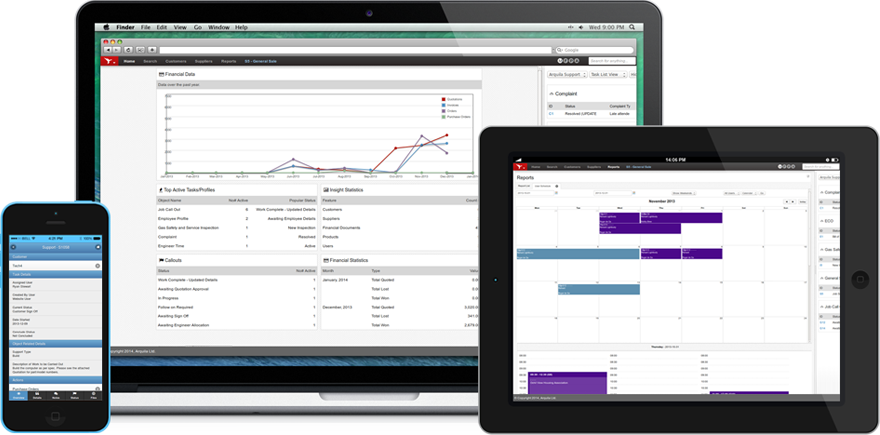
Field types
Text, rich-text (WYSIWYG), checkbox, managed dropdown, client lookup, date/time scheduling, cross-object reference, and pure layout/spacer elements — a fully data-driven form builder.
Cross-object references
Any object can reference another, pull through related data automatically, and jump directly to the linked record — including chains of related follow-up visits auto-created from an originating job.
Intelligent assignment
New records can auto-route to whichever team member currently has the lightest workload of that object type, decided live at the moment of creation.
Per-record analytics
Every object instance gets an automatic status timeline and time-in-status breakdown, with no extra configuration required.
2. CRM & client management
The client record is genuinely extensive: business or individual type (with the form adapting live to which), three independent address blocks (shipping/billing/registered), full contact details, a portal login password, VAT number, configurable payment terms including special Pending Review / Cash on Delivery / Account on Hold states, credit limit, multi-currency support, a per-client default pricing tier, retention percentage handling for construction/services-style billing, business sector classification, an assigned account manager, and one admin-nameable custom field available on every client. Duplicate business names are blocked at the point of entry rather than silently creating a second record.
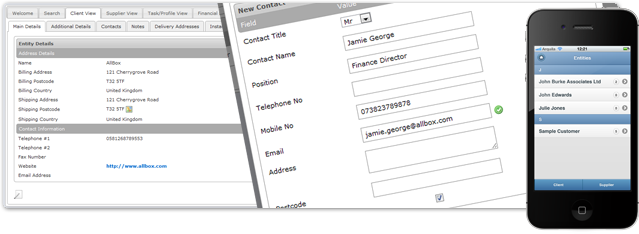
What's built around every client record
- Full contact management — unlimited named contacts per client, with a "receives financial communication" flag per contact and soft-archive rather than deletion, so historical documents stay correctly attributed.
- Portfolio view — a single consolidated, collapsible dashboard of literally everything linked to a client across the whole system, each row deep-linking straight into the underlying record — a genuine 360° view of a customer.
- Running notes and call logs — timestamped, user-attributed free-text notes, plus a parallel call-log feature for telesales-style activity.
- Client hours ledger — a running balance-of-hours system for pre-paid/retainer arrangements, with logged time automatically debiting the balance and flagging overflow for separate billing.
- Unlimited named delivery addresses, independent of the client's own billing/shipping/registered addresses.
- Parent/child client hierarchies for head-office/branch account structures.
3. Supplier management
A full mirror of the client-side CRM built for the purchasing side of the business: supplier records with the same three-address structure, VAT number, account number, default currency and payment terms, plus parent/child supplier hierarchies. Supplier contacts can be emailed or SMS'd directly from their record, with a running notes log per supplier.
Per supplier, the system can be configured with a genuine electronic trading (EDI/punch-out style) integration: a pricing-and-availability endpoint and a separate order-processing endpoint, each with its own credentials — letting Insight query a supplier's live stock and pricing directly from inside a quote or purchase order, using an industry-standard distributor XML protocol.
4. Quoting, sales orders & invoicing
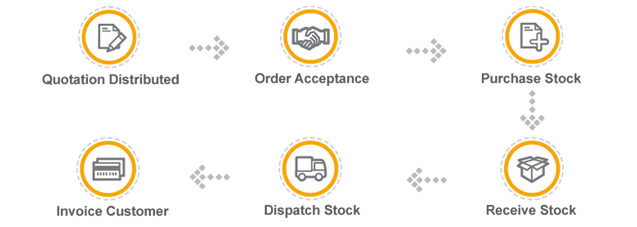
Quotes, sales orders and invoices are one connected document chain — a quote converts to an order, an order converts to an invoice — fully traceable end to end, with multi-currency support (live exchange rates) and multi-branch/multi-company document numbering built in.
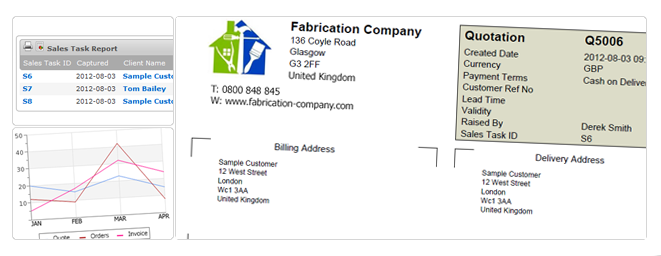
- Import line items directly from stock, a stock category, or a saved template — or build a whole document from an uploaded CSV, with configurable column mapping saved as a reusable template.
- Per-line: shipping, discounts (with a bulk global-adjustment tool), labour lines, retention withholding, individually-tracked serial numbers, a customer PO reference, and a live gross-profit-per-line breakdown with automatic low/negative-margin warnings — a user sees they're about to lose money on a line before it's ever sent.
- Dispatch supports partial/split fulfilment with automatic invoice generation, and re-assigning a task's client mid-flight automatically detaches, re-issues or credits any documents already raised.
5. Purchase orders & procurement
- Spend-limit authorisation — every user has a personal purchase limit (with an optional higher limit for specific nominal codes). A PO over the limit is automatically held in draft and routed for approval, with both approver and requester notified automatically.
- Automatic PO generation from a sales order — tick which stock lines need buying in, and the system groups them by preferred supplier and raises one PO per supplier automatically, pulling cost and tax from that supplier's own costing record.
- Supplier acknowledgement and dispute tracking per line, plus a document repository for order confirmations.
- Goods receipt against a specific PO, confirming quantity and choosing which warehouse location receives the stock.
6. Stock & inventory
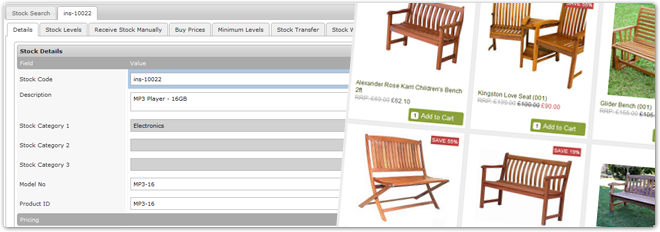
- Multi-location/warehouse tracking — stock level and reorder level tracked independently per location, with live back-order quantities.
- Multi-supplier costing per item, each flaggable as the current preferred source, with live price/availability feed support.
- Full movement tracking — receipt, dispatch, returns, write-offs, and inter-location transfers, each with its own PDF documentation.
- Physical stock takes — snapshot, resume, archive, and generate a system-vs-counted variance report.
7. Finance, payments & credit control
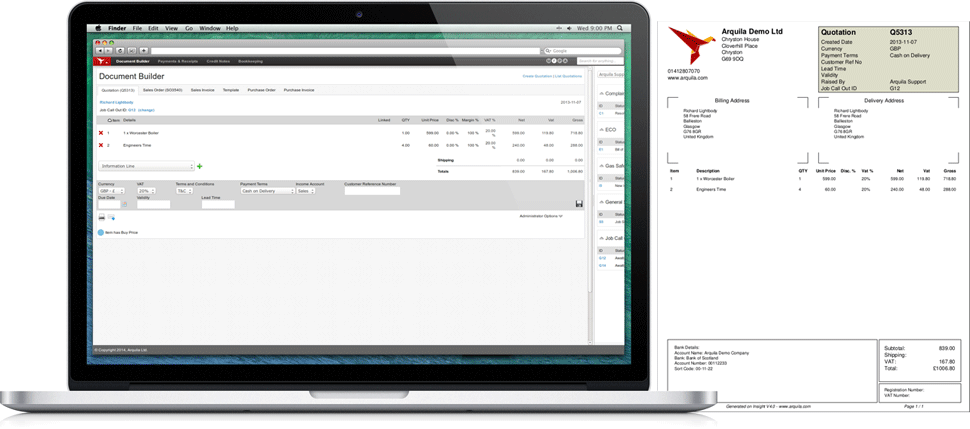
- Payment processing across one or many invoices, including a built-in "pay from customer account" method against store credit.
- Customer credit/store-credit accounts — a running, auditable ledger per client.
- Credit notes with their own document numbering.
- Three statement-run mechanisms — legacy batch, modern resumable email batch, and ad-hoc single-client reminders — each respecting a per-client "exclude me" flag.
- Card payments — full Sage Pay/Protx integration with 3-D Secure, distinct handling for every real-world outcome.
8. Jobs, tasks & the object engine in practice
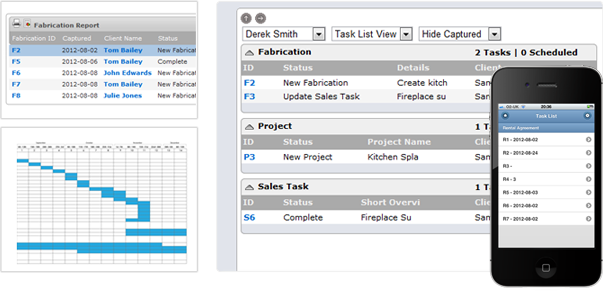
Every user has a personal work queue — a live, auto-refreshing list of every open job/task they have access to. A supervisor or dispatcher can be granted delegated visibility into a colleague's queue, so workload can be reviewed without shared logins.
Job/task profitability is visible at every level — line item, document, individual job, and stock item — feeding directly into dedicated profitability reports. In the reference deployment, the object engine has been configured to run a full field-service equipment-servicing operation: statutory pressure-vessel inspection certificates, detailed electromechanical service records, and automatic follow-up visit scheduling linked back to the original job — genuine proof the same generic engine can be shaped into a fully bespoke, compliance-grade operational system for a specific industry, without a rewrite.
9. Calendar & scheduling
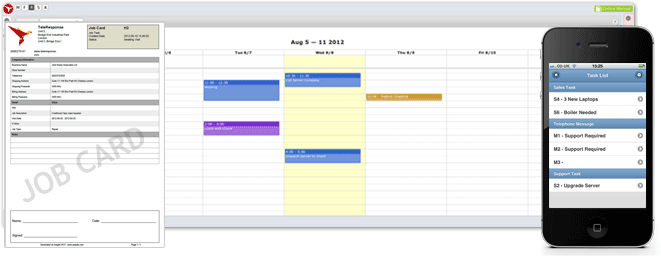
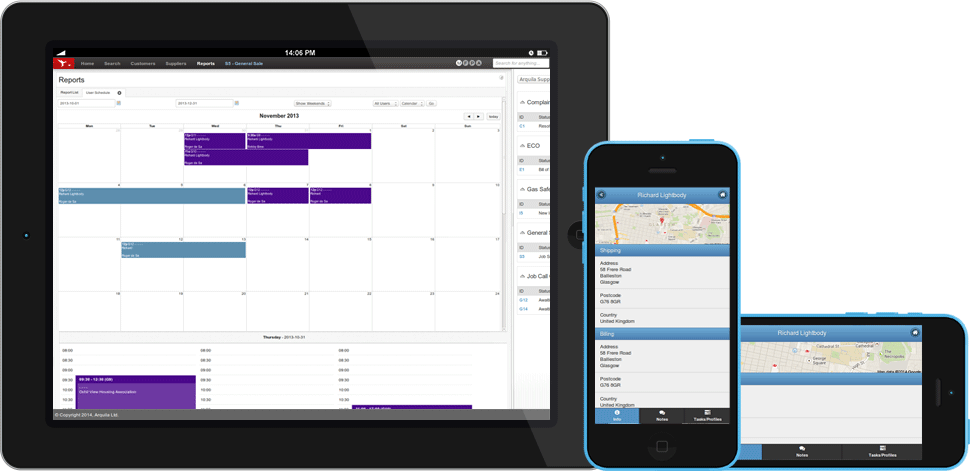
- A modern, branch-filterable calendar (month/week/day) showing every scheduled job, colour-coded by branch, with assigned engineer(s) embedded in the event title.
- External calendar subscription — a live iCal feed per branch, so field staff see their schedule directly in Outlook or Google Calendar. Feeds are secured with an unguessable token; regenerating it is the built-in way to revoke a leaked link.
10. Document management
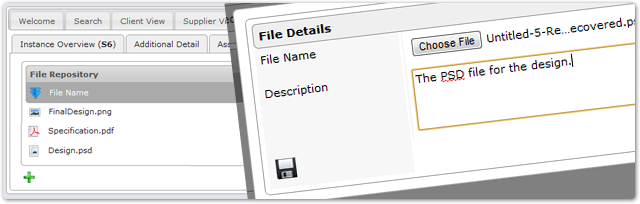
- Files attached at client or job level, with a one-click toggle between the two views.
- Row-level access rights per file — Full Access, Read Only, or No Access — with a safeguard that a file can never be left with zero users able to access it.
- An "engineer-visible" flag marks which files are surfaced to field staff specifically.
- A dedicated chunked bulk-upload tool supports large multi-file uploads (5GB batches) with live progress and duplicate detection.
- For a client running international trade, that same document layer carries real compliance weight — export documentation, customs invoices, and the clearance certificates each shipment needs, attached at the job level rather than living in someone's inbox.
11. Communications: email & SMS
Both channels are deeply wired into the rest of the platform rather than being a separate "marketing" add-on.
- Every outbound email is logged — recipient, sender, subject, both HTML and plain-text bodies, attachment list, and a success/fail flag.
- Automated status-change notifications — a job's status change can automatically email every linked contact a formatted update, attach whichever documents are configured for that status, and fire an SMS to any contact with a mobile number — all from one action.
- SMS is a genuine gateway integration: message concatenation for long texts, live account-balance checking before sending, and full send logging.
12. Reporting
The reporting engine is self-registering — a new report is simply a file dropped into the right folder, with no central list to maintain. Around 50 standard reports ship as a baseline, spanning finance, stock, sales performance, client activity, full audit logs, and a generic Object Report any user can customise, filter, save, and re-run.
On top of that, the reference deployment carries roughly 70 further bespoke reports commissioned over the platform's life for different client industries — training/certification management, event and beauty-industry bookings, maintenance-contract renewal tracking — each client only ever seeing the reports built for them. This is the clearest evidence of Insight's real breadth: one reporting engine, extended industry after industry, without ever needing its core rebuilt.
13. Modules — the extensible plugin layer
Beyond the core system, Insight has a separate, equally self-registering modules layer for optional capability: a CSV-to-stock/quote importer, a mail-merge document generator, a standalone bulk SMS sender, and a marketing list-search-and-export tool ship as standard, alongside client-specific modules built for particular industries. Like reports, a new module is added by dropping a file into a folder — the platform is built to be extended without touching its core.
14. Integrations
Sage 50 accounting export
Five distinct CSV export types in Sage's standard Audit Trail Import format, with per-record validation before a batch is allowed to export.
Modern "IFS" accounting export
A scheduled export pipeline running automatically every night, emailing whichever exports actually contain data, plus a safe "test send" mode.
Supplier price & availability lookup
A configurable, industry-standard XML integration for live price and stock-availability checks, surfaced as an inline button inside quoting screens.
Card payments (Sage Pay/Protx)
Server-to-server card processing with full 3-D Secure support, reconciled against the gateway's own transaction reference.
15. Bulk data & migration tooling
A dedicated chunked bulk-uploader sits alongside a library of purpose-built migration utilities for bringing a new client's data in cleanly: bulk client and supplier onboarding from legacy system exports, and import of historical sales orders, invoices, purchase orders and stock data — evidence that onboarding a new business onto Insight, including its existing trading history, is a well-trodden, repeatable process.
16. Administration, users & permissions
Around 50 distinct configuration screens cover every aspect of a deployment: global display and letterhead defaults; company information; user management with a granular, individually-toggleable permission set and numeric spending-limit fields; user groups and delegated visibility; the entire object-engine configuration surface; stock configuration; and financial setup including labour rate cards distinguishing cost versus charge-out rate.
A dedicated database-maintenance toolkit gives administrators deliberate, audited escape hatches for correcting mistakes — in what is otherwise a carefully append-only, audit-logged system.
17. Unattended automation
Two scheduled jobs run without any human involvement: the engineer calendar feed generator, refreshing every 15 minutes, and the nightly accounting export — engineered to fire exactly once per calendar day, skip sending entirely on a day with nothing to report, and mark itself complete before attempting to send, so a failed email can never cause a duplicate export downstream.
18. Nineteen years of continuous development
Insight's own schema history tells a genuine growth story: multi-currency invoicing was retrofitted onto an originally single-currency engine; the supplier module was built as a full mirror of the client CRM rather than a stripped-down afterthought; expense claims, per-document-type branding, and stock VAT costing were all added as real needs grew. The platform's internal identifier — Insight V3.2 — reflects a product still being actively versioned and developed, not a static legacy system. The clearest proof of this maturity is breadth: one core engine now runs field-service engineering, professional training and certification, event and beauty-industry booking management, and general trade/services businesses, each with its own bespoke reports, object types and workflows layered on the same unchanged foundation.
This is what nineteen years of production engineering looks like
It's also exactly what we bring to building something new for you.
Tell us what you're trying to build